Why Gilbert Tile Roofs Fail at the Underlayment, Not the Tile
The tile on your Gilbert roof will outlast the house. The underlayment underneath is the part that fails — and why fifteen-year-old master-planned homes are all in the replacement window right now.
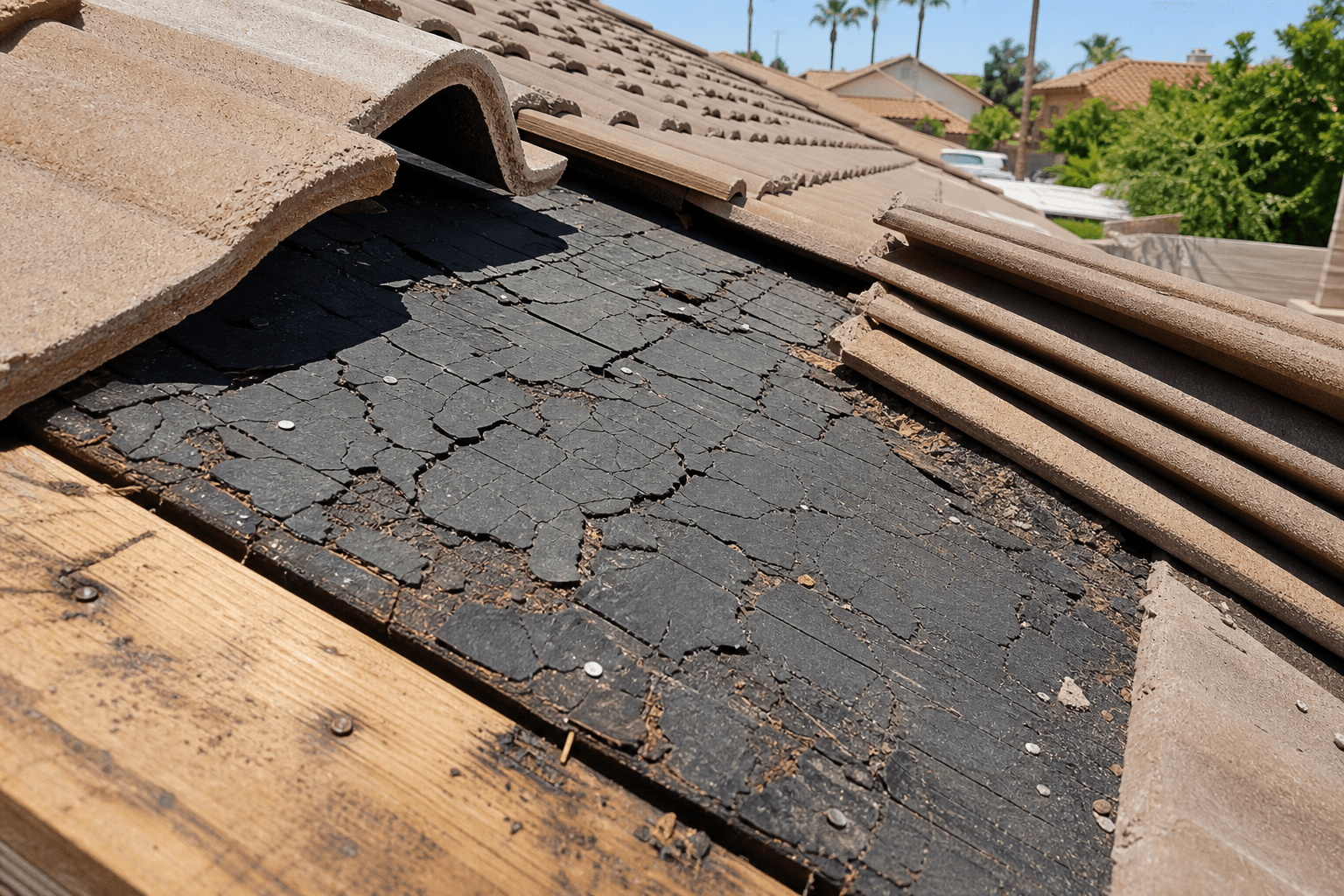
Tile roofs get a bad reputation in Gilbert. They shouldn’t. The tile itself is nearly permanent. Concrete and clay tile in Arizona will outlast the house, outlast the mortgage, and outlast most of the furniture inside. That’s not the problem.
The problem is the component underneath the tile, the one that actually keeps water out of your home: the underlayment.
What the underlayment actually does
Underlayment is a waterproof membrane installed between the roof deck and the tile. Tile isn’t the waterproofing layer. Tile is the shell — it keeps UV off the underlayment, it takes the direct impact from hail or a branch, and it handles most of the wind-driven water. But once water gets past the tile (and in a Gilbert monsoon, it always does), the underlayment is the thing between that water and your ceiling.
When we quote a “tile roof reinstallation” on a fifteen-to-twenty-year-old Gilbert home, we’re almost never replacing the tile. We’re lifting the tile, tearing off the failed underlayment, and putting down new membrane. The tile goes back on.
Why underlayment fails in Gilbert specifically
Two big reasons: heat and UV.
Under Arizona tile in summer, the underlayment regularly sees temperatures well above 160°F. A standard 30-pound asphalt-saturated felt — which is still what went under a huge percentage of Gilbert’s tile roofs built between 1998 and 2010 — was never designed for sustained exposure at those temperatures. The asphalt in the felt cooks, the fibers oxidize, and the membrane starts to crack.
UV is the second accelerator. Anywhere the tile isn’t perfectly lapped — at rake edges, at valleys, at penetrations, under broken tiles, anywhere the sun hits the underlayment directly — the membrane starts UV-degrading almost immediately. By year ten on a standard 30-lb felt, those areas are done. By year fifteen to twenty, the rest of the roof is catching up.
What that looks like on your roof
Here’s the frustrating part: you almost never see the underlayment fail. The tile looks exactly the same from the curb. Your neighbor’s roof also looks fine. And then one monsoon, a storm with real sideways rain comes through, water finds one of the brittle, cracked sections, and it shows up as a stain on your hallway ceiling.
The homeowner’s reasonable question is, “What tile got broken?” The answer is “None. The tiles are fine. The underlayment gave up.”
What we actually check
When one of our roof inspectionson a Gilbert tile roof, an estimator isn’t just looking at the tile. We’re pulling a few tiles in representative areas — a valley, a rake edge, the south-facing slope, somewhere near a penetration — and looking at the felt directly. A ten-minute sampling answers the question definitively.
What we’re looking for: Is the asphalt still soft and flexible? Or is it brittle enough that it cracks when we handle it? Is there physical separation between the felt and the deck? Are the fibers still intact, or are they oxidized and fragile?
What we replace it with
When we reinstall a Gilbert tile roof, we specify a synthetic high-temperature underlayment— a polyolefin or modified SBS membrane rated for continuous high temperature exposure. These membranes will run 25 to 35 years in Gilbert’s climate, versus the 15 to 20 you’ll get from a standard 30-lb felt.
The cost difference between “do it right” and “do it cheap” on the underlayment is a few percent of the total project — because the labor is the same either way, and the labor is where the money is. A contractor who quotes you 30-lb felt for your Gilbert reroof is leaving half the roof’s lifespan on the table to save you three percent on the price.
When to do it
If your Gilbert tile roof is fifteen years old or more — and most homes in Power Ranch, Seville, Val Vista Lakes, Layton Lakes, and Morrison Ranch qualify right now — the right question isn’t “does my roof need to be replaced?” It’s “what does my underlayment look like?”
We’ll come out, walk the roof, pull a few tiles, and tell you honestly. If you’ve got five more years on the current underlayment, that’s what we’ll say. If it’s at the end of its life, we’ll quote the reinstallation with clear material specs and a written scope. Either way, you’ll have better information than you had this morning.
Request an inspection, or read more about concrete and clay tile roofing and what it actually entails in Gilbert’s climate.
HOA Architectural Review for Roofing in Power Ranch, Seville, and Val Vista Lakes
What to expect when you file your HOA architectural review package for a roof in Gilbert's master-planned communities — community-specific timelines, what the committee actually cares about, and how to avoid kickback delays.
How to Tell if Your Gilbert Roof Has Monsoon Damage (and What to Do About It)
Lifted ridge tiles, displaced bird stops, failed flashing, and the water intrusion that follows. A plain-language guide to monsoon damage on Gilbert roofs and how to handle the insurance process.